|
|
Библиотека, архив книг, скачать книги
 | Avise (genetics, Univ. of Georgia) explains thoroughly how evolution
operates on a genetic level. His goal is to show that humans can look
to this information as a way to answer fundamental questions of life
instead of looking to traditional religious beliefs. Unfortunately,
what could have been a fascinating and provocative book for informed
lay readers turns out to be a rather average academic tome, written in
a dense, scholarly style that is sometimes hard to get through.
Although Avise includes some very interesting discussions of ethical
concerns related to genetic issues, his book is recommended only for
academic collections and some larger public libraries. ??“ Eric D.
Albright, Duke Medical Ctr. Lib., Durham, NC |
|
 | Dr. Clark is an independent research scientist. Dr. Clark has a
Bachelor of Arts, Magna Cum Laude, and the Master of Arts with High
Honors from the University of Saskatchewan, Canada. Then she studied
for two years at McGill University before attending the University of
Minnesota and obtaining her doctorate degree in physiology in 1958.
After doing government sponsored research for almost ten years at
Indiana University, she began private consulting in nutrition in 1979. |
|
 | Michael Yudell (Editor), Rob Desalle (Editor), ?«The Genomic Revolution - Unveiling the Unity of Life?»
National Academies Press
ISBN 0309074363
February 2002
Format: PDF 249
pages 14709 Kb
|
|
 | From Library Journal With nearly 300
illustrations and full-color maps, this latest work from Oxford
historian Fernandez-Armesto, editor of The Times Guide to the Peoples
of Europe (Times Bks., 1994), is a fascinating companion volume to The
Times Atlas of European History (HarperCollins, 1994). The author
traces the cultural, social, and political evolution of Europe from its
origins (c.10,000 B.C.) to the present day. The presentation is not a
succession of facts and dates but a sweeping overview of European
currents, interweaving art, ideology, and socioeconomic conditions. The
narrative is very readable but would have been enhanced by chronologies
similar to those used at the bottom of pages in The Harper Atlas of
World History (HarperCollins, 1992. rev. ed.). While the absence of
such chronologies may limit the usefulness of this publication as a
reference tool, it is highly recommended for the history collections of
most public and academic libraries.?Edward K. Werner, St. Lucie Cty.
Lib. System, Ft. Pierce, Fla. Copyright 1996 Reed Business Information, Inc. |
|
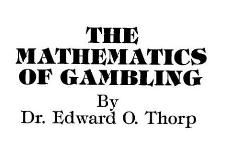 | The Author is adjucent professor of finance and mathematics at the University of California at Irvine.
Thorp's interest in gambling dates back almost 30 years, while he was
still in graduate school at UCLA. His experience has been dated in this
book. |
|
|